FDA approved for people 2 years and older with obesity due to POMC, PCSK1, or LEPR deficiency

Discover what's
possible when you
Target the Source

Woman and young girl at a carnival with a representation of a human brain

Actor portrayals

The first and only treatment to target MC4R pathway impairment in the brain for people with POMC, PCSK1, or LEPR deficiency

Woman and young girl at a carnival with a representation of a human brain

Actor portrayals

What is IMCIVREE?

IMCIVREE is the first and only FDA-approved treatment for people with obesity due to proopiomelanocortin (POMC), proprotein convertase subtilisin/kexin type 1 (PCSK1), or leptin receptor (LEPR) deficiency to help them lose weight and keep the weight off.

  • IMCIVREE is a prescription medicine for adults and children 2 years and older with obesity due to POMC, PCSK1, or LEPR deficiency as confirmed by genetic testing
  • IMCIVREE targets the impaired melanocortin-4 receptor (MC4R) pathway in the brain, a root cause of weight gain and hunger in POMC, PCSK1, or LEPR deficiency

What are POMC, PCSK1, and LEPR deficiencies?

DNA double helix icon

POMC, PCSK1, and LEPR deficiencies are all rare genetic diseases that cause obesity. These conditions occur when both copies of the relevant gene (one inherited from the mother and one from the father) have a specific change, or variant. These genetic variants affect how the brain controls feelings of hunger, which can lead to weight gain.

How does POMC, PCSK1, or LEPR deficiency affect weight and hunger?

In POMC, PCSK1, or LEPR deficiency, obesity and insatiable hunger are caused by a genetic change that makes it difficult for the brain’s hunger signaling pathway to help you feel full.

Brain icon - Black dot over hypothalamus

The key area of the brain that communicates being hungry or full is known as the hypothalamus—think of the hypothalamus as a neighborhood within the brain

Cargo truck icon with green diamond

In this neighborhood, there are roads that allow trucks carrying messages about hunger and fullness to travel to and from the brain; one road is called the MC4R pathway

Stoplight icon

When the POMC, PCSK1, or LEPR gene is normal, without a variant (or change), the traffic light works correctly—the road (MC4R pathway) is open, and the trucks can deliver messages to the brain that the body is satisfied and doesn't need more food

In people living with POMC, PCSK1, or LEPR deficiency, the signals that turn hunger “off” don’t work correctly in the brain
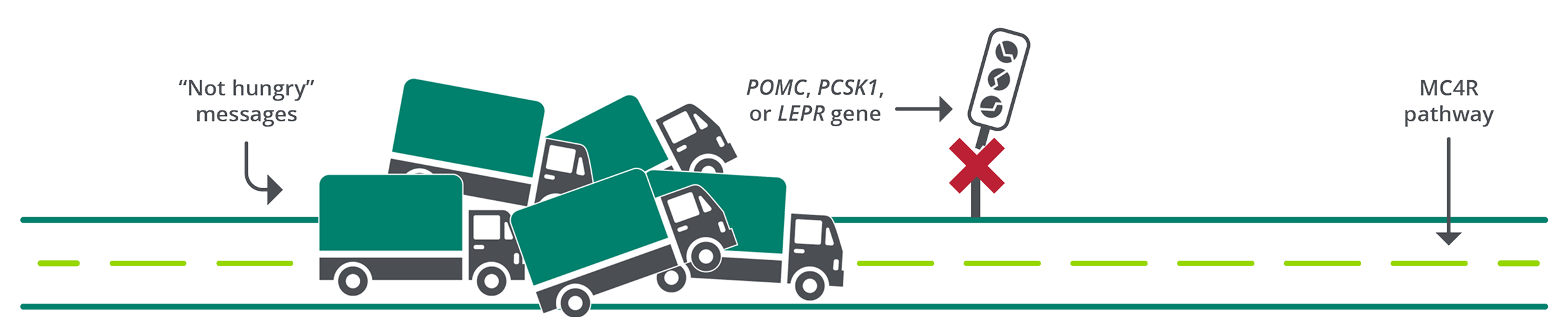
Traffic accident drawing - MC4R pathway and 'not hungry' messages

When the POMC, PCSK1, or LEPR gene has a variant (or change), the traffic light is broken, which causes a traffic jam. The trucks can no longer travel along the road (MC4R pathway) to properly deliver messages to the brain that the body is satisfied and doesn’t need more food. Instead, the brain believes that the body is still hungry.

How does IMICVREE work?

IMCIVREE targets the impaired MC4R pathway in the brain, a root cause of obesity and hunger in people living with POMC, PCSK1, or LEPR deficiency.

IMCIVREE is designed to reestablish function to the road (MC4R pathway) so trucks can deliver messages to the brain that the body is satisfied and no longer hungry

Flowing traffic - MC4R pathway guided by IMCIVREE®

Think of IMCIVREE as a traffic officer. When the traffic light is broken, the traffic officer directs trucks on the road (MC4R pathway), allowing them to deliver messages to the brain that the body is satisfied and doesn't need more food. This is how IMCIVREE works to help the MC4R pathway function properly.

Resource page icon

Resources to support you along the way

Rhythm InTune Patient Education Managers (PEMs)* offer educational tools to help you learn more about POMC, PCSK1, or LEPR deficiency, and provide personalized ongoing support to help you stay informed throughout your treatment journey.

*Patient Education Managers are employees of Rhythm Pharmaceuticals and do not provide medical care or advice. We encourage you to always speak to your healthcare providers regarding your medical care.

Ages 2 to <6

Learn about the IMCIVREE clinical trial results for ages 2 to less than 6.

Ages 6+

Learn about the IMCIVREE clinical trial results for ages 6 and older.

What is IMCIVREE?

IMCIVREE is a prescription medicine used in adults and children 2 years of age and older with obesity due to the genetic conditions pro-opiomelanocortin (POMC), proprotein convertase subtilisin/kexin type 1 (PCSK1), or leptin receptor (LEPR) deficiency, to help them lose weight and keep the weight off.

Your healthcare provider should order a genetic test to confirm POMC, PCSK1, or LEPR deficiency before you start using IMCIVREE.

IMCIVREE is not for use in people with the following conditions because it may not work:

  • Obesity due to suspected POMC, PCSK1, or LEPR deficiency not confirmed by genetic testing or with benign or likely benign genetic testing results
  • Other types of obesity not related to POMC, PCSK1, or LEPR deficiency, or other FDA-approved uses of IMCIVREE, including obesity associated with other genetic conditions and general obesity

It is not known if IMCIVREE is safe and effective in children under 2 years of age.

Important Safety Information

Do not use IMCIVREE if you have had a serious allergic reaction to it or any of its ingredients. Serious allergic reactions, including anaphylaxis, can happen.

Before you use IMCIVREE, tell your healthcare provider about all your medical conditions, including if you:

  • Have or have had areas of darkened skin, including skin discoloration (hyperpigmentation)
  • Have or have had depression, or suicidal thoughts or behavior
  • Have kidney problems
  • Are pregnant or planning to become pregnant. Losing weight while pregnant may harm your unborn baby. Your healthcare provider may stop your treatment with IMCIVREE if you become pregnant. Tell your healthcare provider if you become pregnant or think you might be pregnant during treatment with IMCIVREE
  • Are breastfeeding or plan to breastfeed. It is not known if IMCIVREE passes into your breast milk. You should not breastfeed during treatment with IMCIVREE

Tell your healthcare provider about all the medicines you take, including prescription and over-the-counter medicines, vitamins, and herbal supplements.

See the detailed Instructions for Use that come with your IMCIVREE to learn how to prepare and inject IMCIVREE, and how to properly throw away (dispose of) used syringes and needles.

What are the possible side effects of IMCIVREE?
IMCIVREE may cause serious side effects, including:

  • Male and female sexual function problems. IMCIVREE can cause an erection that happens without any sexual activity in males (spontaneous penile erection) and unwanted sexual reactions (changes in sexual arousal that happen without any sexual activity) in females. If you have an erection lasting longer than 4 hours, get emergency medical help right away
  • Depression and suicidal thoughts or actions. You or a caregiver should call your healthcare provider right away if you have any new or worsening symptoms of depression, suicidal thoughts or behaviors, or any unusual changes in mood or behavior
  • Serious allergic reactions. Stop taking IMCIVREE and get medical help right away if you have any symptoms of a serious allergic reaction including: swelling of your face, lips, tongue, or throat; problems breathing or swallowing; severe rash or itching; fainting or feeling dizzy; rapid heartbeat
  • Increased skin pigmentation, darkening of skin lesions (moles or nevi) you already have, and development of new skin lesions. These changes happen because of how IMCIVREE works in the body and will go away when you stop using IMCIVREE. You should have a full body skin exam before starting and during treatment with IMCIVREE to check for skin changes

The most common side effects of IMCIVREE include darkening of the skin, injection site reactions, nausea, headache, diarrhea, stomach pain, vomiting, depression, and an erection that happens without any sexual activity in males.

These are not all the possible side effects of IMCIVREE. Call your doctor for medical advice about side effects. You are encouraged to report negative side effects of prescription drugs to FDA. Visit www.fda.gov/medwatch or call FDA at 1-800-FDA-1088.

Please see full Prescribing Information, including Patient Information.

Use and Important Safety Information

What is IMCIVREE?

IMCIVREE is a prescription medicine used in adults and children 2 years of age and older with obesity due to the genetic conditions pro-opiomelanocortin (POMC), proprotein convertase subtilisin/kexin type 1 (PCSK1), or leptin receptor (LEPR) deficiency, to help them lose weight and keep the weight off.

Your healthcare provider should order a genetic test to confirm POMC, PCSK1, or LEPR deficiency before you start using IMCIVREE.

IMCIVREE is not for use in people with the following conditions because it may not work:

  • Obesity due to suspected POMC, PCSK1, or LEPR deficiency not confirmed by genetic testing or with benign or likely benign genetic testing results
  • Other types of obesity not related to POMC, PCSK1, or LEPR deficiency, or other FDA-approved uses of IMCIVREE, including obesity associated with other genetic conditions and general obesity

It is not known if IMCIVREE is safe and effective in children under 2 years of age.

Important Safety Information

Do not use IMCIVREE if you have had a serious allergic reaction to it or any of its ingredients. Serious allergic reactions, including anaphylaxis, can happen.

Before you use IMCIVREE, tell your healthcare provider about all your medical conditions, including if you:

  • Have or have had areas of darkened skin, including skin discoloration (hyperpigmentation)
  • Have or have had depression, or suicidal thoughts or behavior
  • Have kidney problems
  • Are pregnant or planning to become pregnant. Losing weight while pregnant may harm your unborn baby. Your healthcare provider may stop your treatment with IMCIVREE if you become pregnant. Tell your healthcare provider if you become pregnant or think you might be pregnant during treatment with IMCIVREE
  • Are breastfeeding or plan to breastfeed. It is not known if IMCIVREE passes into your breast milk. You should not breastfeed during treatment with IMCIVREE

Tell your healthcare provider about all the medicines you take, including prescription and over-the-counter medicines, vitamins, and herbal supplements.

See the detailed Instructions for Use that come with your IMCIVREE to learn how to prepare and inject IMCIVREE, and how to properly throw away (dispose of) used syringes and needles.

What are the possible side effects of IMCIVREE?
IMCIVREE may cause serious side effects, including:

  • Male and female sexual function problems. IMCIVREE can cause an erection that happens without any sexual activity in males (spontaneous penile erection) and unwanted sexual reactions (changes in sexual arousal that happen without any sexual activity) in females. If you have an erection lasting longer than 4 hours, get emergency medical help right away
  • Depression and suicidal thoughts or actions. You or a caregiver should call your healthcare provider right away if you have any new or worsening symptoms of depression, suicidal thoughts or behaviors, or any unusual changes in mood or behavior
  • Serious allergic reactions. Stop taking IMCIVREE and get medical help right away if you have any symptoms of a serious allergic reaction including: swelling of your face, lips, tongue, or throat; problems breathing or swallowing; severe rash or itching; fainting or feeling dizzy; rapid heartbeat
  • Increased skin pigmentation, darkening of skin lesions (moles or nevi) you already have, and development of new skin lesions. These changes happen because of how IMCIVREE works in the body and will go away when you stop using IMCIVREE. You should have a full body skin exam before starting and during treatment with IMCIVREE to check for skin changes

The most common side effects of IMCIVREE include darkening of the skin, injection site reactions, nausea, headache, diarrhea, stomach pain, vomiting, depression, and an erection that happens without any sexual activity in males.

These are not all the possible side effects of IMCIVREE. Call your doctor for medical advice about side effects. You are encouraged to report negative side effects of prescription drugs to FDA. Visit www.fda.gov/medwatch or call FDA at 1-800-FDA-1088.

Please see full Prescribing Information, including Patient Information.